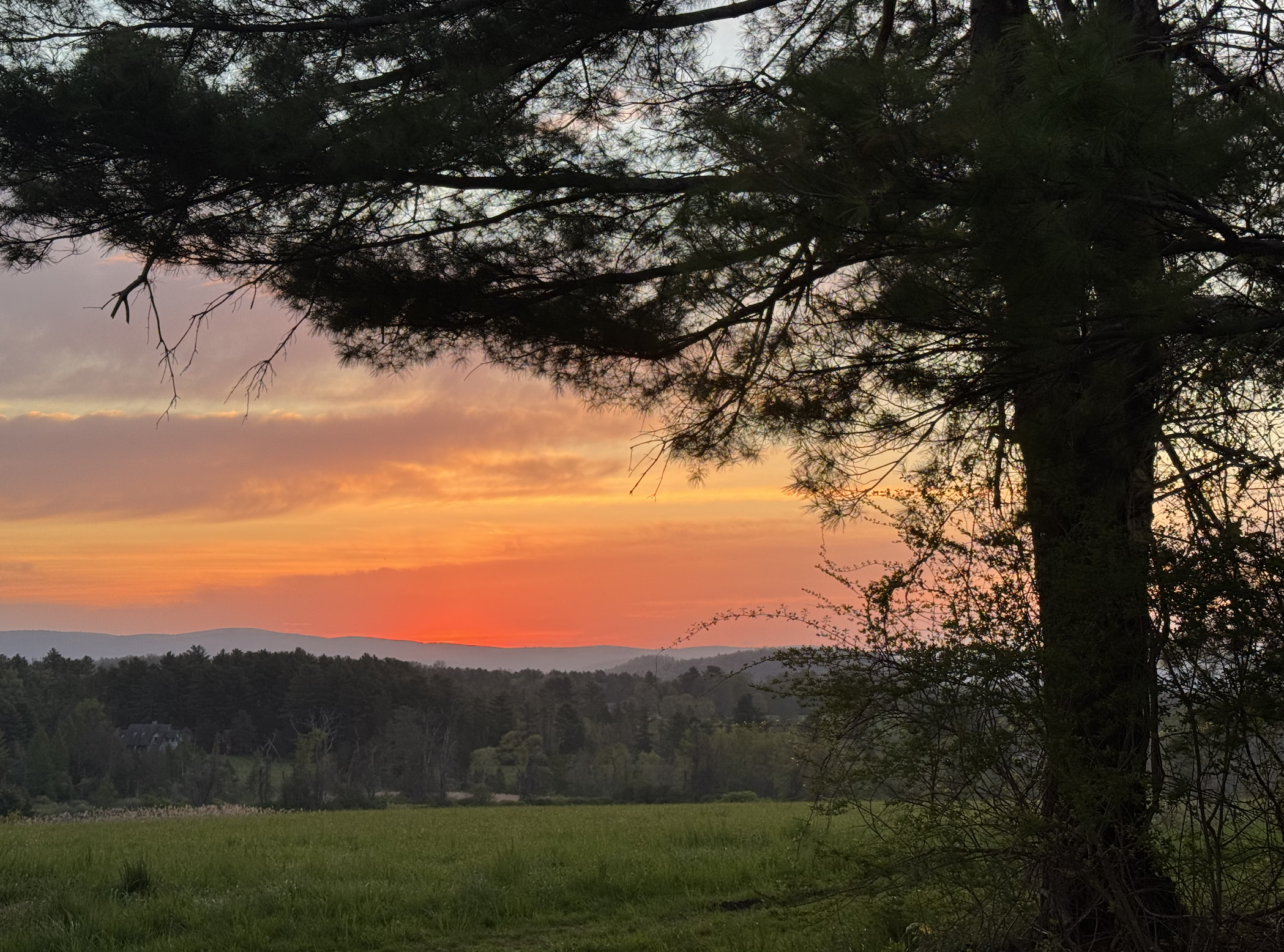
The photo above has nothing to do with the post below, but it's an unfiltered image of a field near my house. Sometimes, I can't believe I live in such a beautiful place.
As we start the new school year, another one in which much of my job is going to be convincing kiddos to do their own work, I've been thinking about how to make this case so that they'll hear my words and believe that they even if they don't get caught, they're still better off taking this advice.
I could tell them about the woman, we'll call her K, who, in her third year at Amherst College, was a resident advisor in my first-year dorm. The following year, three weeks before her graduation, she was expelled for plagiarizing an essay. It was her first offense. No, that's not right. It was the first time she got caught cheating, but probably not the first time she cheated.
In 1989, when that happened, it was more difficult to get caught because there was no easy way to find, with a few clicks, everything that's ever been published on a topic. I'm sure that K knew that the chance of her transgression's getting discovered was minimal, but she wasn't thinking about the fact that it was not zero.
But my students, if I tell them this true story, will probably think that they're smarter than K, that they can hide their tracks better, that the Internet offers them new shortcuts that are less detectable and more likely to lead to success (with success being defined as not getting caught).
Maybe that's all true, so it's not foolish of them to wonder why they should do their own work.
One could argue that knowledge is its own reward. One could point out that the whole point of going to school is to learn to think and do things that will give one a happier and more fulfilling life. One could even explain that if people rely on computers to do everything, we'll make ourselves superfluous.
But I'm not sure those arguments will do any good. All people, but maybe especially young ones, succumb to the present-tense bias. What we want right now calls to us louder than what we want for the future. It's hard to fight against our impulses to go with what's easy and fun in the moment.
I'm hopeful that asking the following questions will help my students make wiser choices about how much of their own work to do.
- Would you be embarrassed to tell your peers, teachers, and family about your work process?
- Does how you spend your time honor the sacrifices and effort you and your family took to get you to where you are today?
- Would you behave the same way if you knew that you'd be famous one day and have paparazzi and biographers digging into your every move to make it public?
- What have you done in your life that made you feel most proud and accomplished? How did you do it?
- What traits do you value most in your heroes? How did they acquire and sustain those traits through hard times?
What other questions should I be asking my students? Am I fighting a losing battle? What skills will independent, responsible adults need in a world of AI? Please share your responses in the comments.