If you're not a grammar geek (as I am) or a teacher (yep, also true for me), you might be thinking that you want no part of this post, but please read it anyway for the following reasons:
- You're already here. It would be a waste of time to read this far and not both to finish the essay.
- You might learn to think about grammar more expansively. It's not just rules that English teachers use to steal points from students' essays; it's the basis for communication.
- You want to support me in my writing endeavors.
- What else would you do with the next three minutes of your life? Might as well stay here.
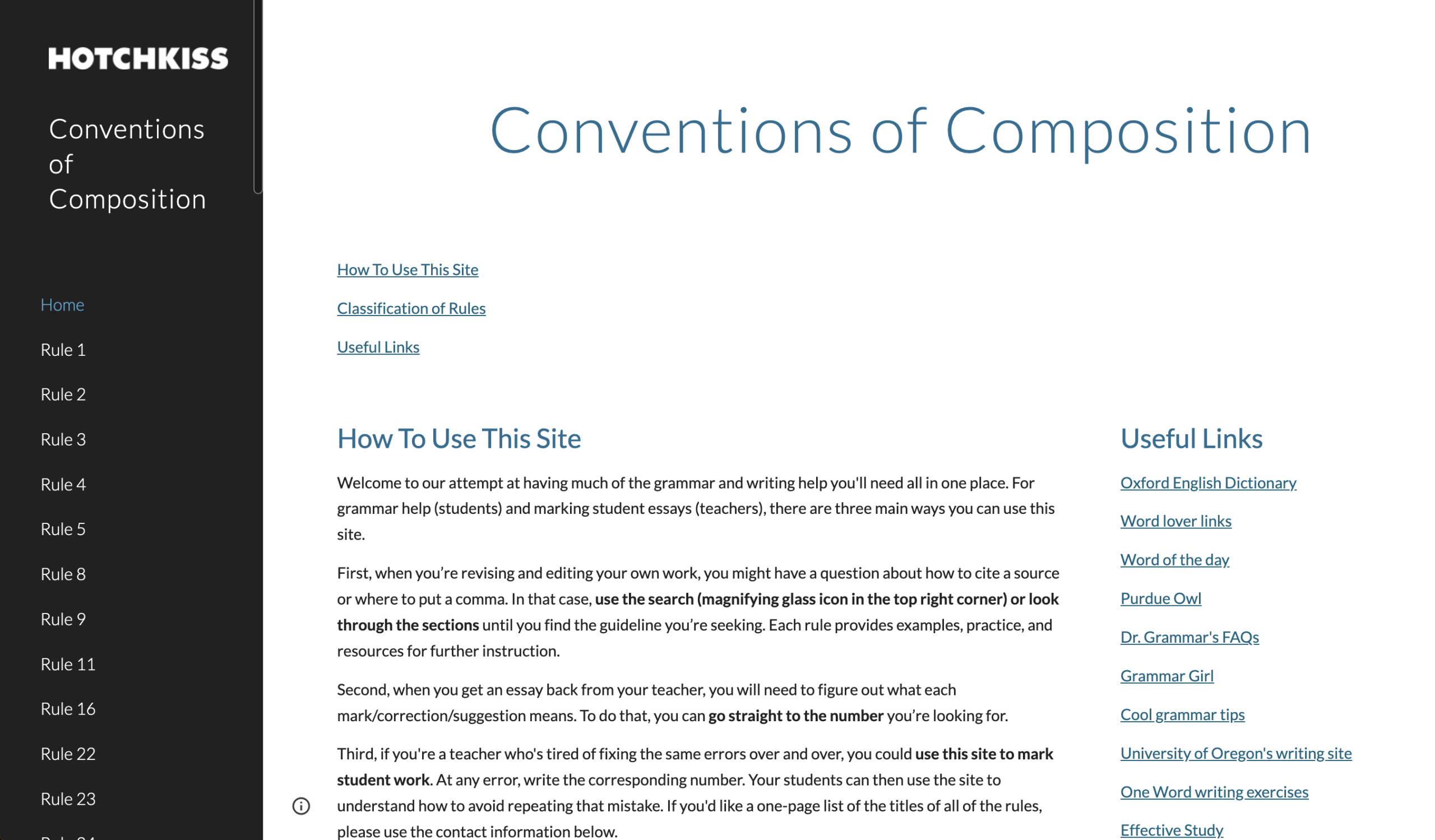
Okay, so now you've committed to reading about why I think all teachers of writing should use the Conventions of Composition website to mark student essays. Thank you.
Given that all students (humans, really) would rather do well than poorly, there are only two possible reasons for students to submit work with errors in it. First, they didn't pay enough attention to what they were doing. Second, they don't know how to do the task correctly. For the former, they get the grades they deserve and learn that attention to tasks is critical to success.
The latter is, of course, where teachers' work lies. If I mark a mistake, let's say a missing comma, for example, and a student sees the note, they've learned that a comma goes there, in that spot. That piece of information is useful only if they're going to write the same sentence again later. Frankly, this scenario seems. unlikely. If, instead, I write a 1, my student can go to rule 1 on the Conventions of Composition website to learn why that compound sentence needs a comma before the coordinating conjunction. If said student doesn't understand the rule, he/she/they can do the practice sentences and read the additional links that explain it. That lesson is more useful in the long run than knowing that one specific sentence needs a comma.
So here are a few questions for you:
- Why would any teacher marking a paper not want to use a system that both notes and teaches in response to every error?
- Are there other aspects of teaching that could benefit from a self-help website like this one?
- What are all the ways that grammar or this kind of self-help site can be helpful in life (especially for people who no longer write essays for teachers)?
The Conventions of Composition website offers guidance on many rules of grammar, punctuation, and content. Moreover, it has some hidden gems. If you want to learn a fun one, check out rule 67, and, after, please share your thoughts about this post in the comments.